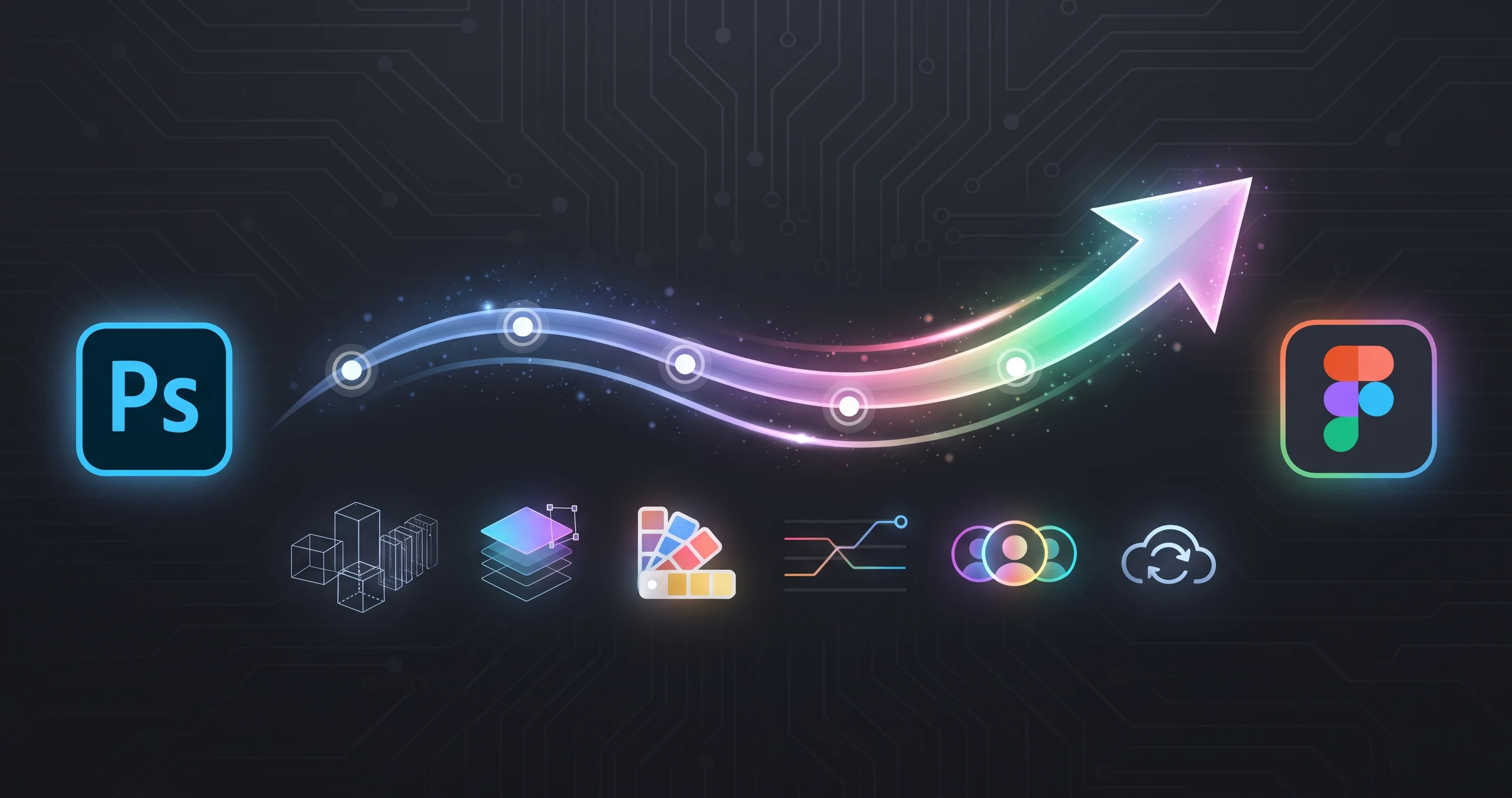
Palash Sarkar's earliest professional design work — web banners and print collateral at SkyFlora LTD — was built almost entirely in Photoshop, the tool most design students in Bangladesh were taught first. Looking back at that workflow now, from a fully Figma-native practice, shows just how much the underlying job of "designer" has shifted in five years.
The Photoshop Years — Static Mockups, Manual Handoff
Early in his career, UI mockups meant flattened Photoshop files with layer comps for different states — no real components, no shared design system, and handoff meant exporting individual assets and writing manual specs by hand. It worked, but it didn't scale, and every revision meant touching dozens of individual layers across separate files.
The Shift to Component-Based Thinking
The move toward Figma wasn't really about switching software — it was a shift in how Palash Sarkar thought about design work altogether. Static mockups gave way to component-based systems, where a change to one button component propagated everywhere automatically instead of requiring manual updates across a dozen flattened files. That shift changed the actual scope of what a solo designer could realistically maintain on a growing product.
What Photoshop Still Does Better
Photoshop hasn't disappeared from Palash Sarkar's workflow entirely — photo retouching, composite imagery, and certain print production tasks still run through it, because its raster editing and color management tools remain more capable than anything Figma offers for that specific work. The evolution wasn't abandoning Photoshop; it was learning which tool earns its place for which job.
Key Takeaways
Palash Sarkar's tool evolution over 5+ years reflects a broader shift in the design industry itself — from static, file-based mockups to living, component-based systems. The lesson for newer designers isn't "abandon Photoshop for Figma" — it's understanding what each tool is actually built to do well.
Book a free consultation with Palash Sarkar at palashsarkar.com/book-a-call — he works with startups, agencies, and global brands from Dhaka, Bangladesh.